

Latest AI News October 2025: Complete Breakthroughs, Regulation & Industry Roundup

October 2025 was a big month for AI — and that’s an understatement. OpenAI launched an AI-powered browser that turned heads. The EU’s AI Act deadlines started actually meaning something. Nvidia crossed a $5 trillion valuation. Japan rolled out tighter rules around generative AI. And all of this happened in just 31 days. It felt less like a month and more like an entire year squeezed into one.
This roundup breaks down everything that mattered in AI during October 2025. We cover new model releases, regulatory changes, healthcare breakthroughs, market milestones, and the safety debates that will shape how AI develops over the next decade. Whether you build with AI, run a business that uses it, or just want to stay informed — this guide gives you the full picture, all in one place about Latest AI News October 2025.
Latest AI News October 2025 AI Overview: Why This Month Was a Turning Point

In October 2025, “agentic AI” finally shifted from a trendy buzzword to an essential, everyday tool. This month, AI systems did much more than just answer questions. They actively browsed the web, wrote and launched software, bought items on their own, and even guided surgeons in real time. AI no longer just waits for our commands—it takes action.
Simultaneously, regulators around the world moved from drafting policy to enforcing it. The EU AI Act’s General Purpose AI (GPAI) compliance deadline arrived. Japan released updated generative AI guidelines with healthcare-specific provisions. The UK’s Ofcom issued binding AI content standards. The era of “responsible AI” is becoming the era of legally mandated responsible AI.
Financially, the AI sector showed no signs of cooling. Nvidia crossed $5 trillion in market capitalization. ChatGPT surpassed 800 million users. Meta committed $70–72 billion to AI infrastructure through 2025. The question is no longer whether AI will transform industries—it’s whether organizations can keep pace.
AI Model News October 2025: New Releases & Updates

GPT-5, Gemini Ultra & Other Major Model Updates
OpenAI continued rolling out GPT-5 to enterprise customers, and the improvements were hard to ignore. The model handles multi-step reasoning much better than GPT-4o and makes noticeably fewer mistakes. Developers working with it reported stronger performance on complex coding tasks, math proofs, and summarizing long documents.
Google DeepMind’s Gemini 2.5 Pro cemented its spot as one of the best multimodal models available. Google reported that Gemini now reaches over 650 million users across its products.
Researchers at MIT and Stanford paid close attention to how the model handles scientific reasoning. What stood out most was its ability to not just generate mathematical arguments, but also verify whether they actually hold up.
Anthropic updated Claude Sonnet 4.5 with better computer-use capabilities. The model can now interact with web browsers and desktop applications far more reliably than before. Developers building agentic workflows reported that task completion rates improved meaningfully across multi-step automation pipelines.
Meta updated Llama 4, its open-source model, and the changes were straightforward but meaningful — better instruction following and fewer toxic outputs. The open-source community didn’t waste any time. Within just a few days, thousands of fine-tuned versions of the model were already showing up on Hugging Face.
On the smaller-model front, Qualcomm and Apple both made progress on on-device AI. They demonstrated models that run entirely on local hardware, with no cloud connection needed. For industries like healthcare and finance where privacy is non-negotiable, this is a significant step forward.
Sora 2 — OpenAI’s Next-Gen Video Generator

OpenAI officially announced Sora 2 in October 2025, and it’s a massive step up from the original Sora. The first version produced impressive videos but often struggled with physical consistency. Sora 2 fixes that by using a world-model architecture that keeps longer clips visually coherent from start to finish. It also handles complex physics — water, cloth, fire, and human motion — with a level of realism that’s hard to overlook.
Key capabilities of Sora 2 include:
- Generation of up to 4-minute coherent video clips from text prompts
- Image-to-video transformation with high fidelity to source material
- Cinematic style control (lighting, camera angle, film grain)
- Real-time editing through natural language instructions mid-generation
Creative professionals at companies like Adobe, Runway, and Luma got early access and put it to work right away. From producing advertisements to previewing film scenes before production. But the model’s realism also reignited concerns about deepfakes. In response, OpenAI embedded C2PA-compliant watermarking into every Sora 2 output to help track and verify AI-generated content.
OpenAI Atlas Browser Launches October 24, 2025

On October 24, 2025, OpenAI launched Atlas — an AI-native web browser that turned a lot of heads. Unlike traditional browsers, Atlas builds GPT-5 directly into the experience. Instead of clicking through pages, users simply have a conversation with the browser and it does the work.
Atlas comes packed with some genuinely useful features. It summarizes pages in real time, pulls together research from multiple tabs, fills out forms on its own, and handles what OpenAI calls “agentic browsing.” That last one is the big one — Atlas can independently browse multiple pages, book appointments, and compare products without the user lifting a finger.
People quickly compared it to Google Chrome’s AI features and Microsoft’s Copilot browser. But most observers agreed that Atlas is doing something different and more ambitious — it treats the browser as an agent, not just a viewer. That distinction matters. Privacy advocates were quick to raise concerns too, pointing out the data risks that come with an AI that watches everything you do online.
AI Breakthroughs October 2025: Technology Milestones

The Rise of Agentic AI Systems
We might remember October 2025 as the month big businesses fully embraced agentic AI. These AI systems plan, act, and adapt on their own to finish complex tasks. This month, companies finally moved these agents out of testing and into large-scale, everyday use.
Here is how major platforms drove this shift:
- ServiceNow: The company reported a huge milestone. Its AI agents now completely resolve over 40% of IT service requests without any human help.
- Salesforce: The company saw a 300% spike in sign-ups for its Agentforce platform compared to the second quarter of 2025. This platform lets businesses launch independent sales and customer service agents.
- Microsoft: The company officially released the agent mode for GitHub Copilot to everyone. Developers simply describe a feature, and the AI writes, tests, and saves the code completely on its own.
- Anthropic: The company’s Model Context Protocol (MCP) became a widely used standard. MCP gives AI agents a standard way to connect with outside data and tools. By October, developers had published over 2,000 compatible integrations. Now, developers can easily connect AI agents to databases and APIs without writing custom code.
A new survey from McKinsey captured this massive growth. The firm found that 67% of tech leaders are actively launching agentic AI systems right now. That is a huge jump from just 23% in early 2024. It proves exactly how fast this technology grew from a lab experiment into a practical business tool.
Quantum Computing Meets Artificial Intelligence

D-Wave and IonQ: October brought major advances in quantum AI. D-Wave successfully tested a new hybrid algorithm that mixes quantum and classical computing. It solved massive supply chain routing problems much better than traditional methods. At the same time, IonQ published research proving that quantum computers can speed up specific machine learning tasks. Still, researchers warn that widespread, everyday quantum AI remains years away.
Nvidia: For immediate AI needs, Nvidia updated its CUDA-Q framework. Now, developers can use a single interface to write code for both standard GPU clusters and quantum processing units. This hybrid setup lets companies prepare their AI systems for future quantum hardware. Best of all, they will not have to rewrite their entire architecture from scratch.
BTQ Technologies and LuxQuanta: Both companies made headlines with new advances in CV-QKD (Continuous Variable Quantum Key Distribution). This technology actively secures AI networks against future quantum cyberattacks. Protecting AI infrastructure is an urgent priority right now because these systems process highly sensitive healthcare, financial, and government data.
Deep Reasoning Models & World Models

The Rise of World Models: In October 2025, a quiet but important trend emerged. Developers started using world models as the core framework for next-generation AI.
How They Work: Regular language models simply guess the next word in a sequence. However, world models actually learn how physical environments operate. This deep understanding makes them much better at planning, running simulations, and solving physical problems.
Meta’s Big Push: Yann LeCun at Meta strongly champions this approach. He believes world models are the true path to human-level AI. To back this up, Meta’s research division published new test results this month. They proved that AI agents using world models easily beat standard language models at robotics and physical simulations.
Google DeepMind: Google DeepMind is applying the exact same thinking. They are currently using this architecture to improve the physical reasoning skills of Gemini.
What It Means for Developers: The future of development is changing fast. Soon, the next generation of AI coding assistants, robotics systems, and autonomous agents will rely heavily on world models. These new systems will actively understand cause and effect, anticipate future consequences, and plan much further ahead than today’s AI.
Global AI Regulation News October 2025

EU AI Act — October Compliance Updates
The EU AI Act: In October 2025, the EU AI Act officially started enforcing its rules for General Purpose AI (GPAI). This marks a massive turning point for AI companies operating in Europe.
New Rules for GPAI: If an organization shares a foundation model with the public, they must follow strict new guidelines. They must operate transparently and thoroughly evaluate their models. They also have to document their training data, model capabilities, and any known risks.
High-Capability Models: Models trained with massive computing power (over 10^25 FLOPs) face even tougher rules. Their creators must assess systemic risks, report incidents directly to the EU AI Office, and conduct mandatory red-team security testing. Major players like OpenAI, Google, Anthropic, Meta, and Mistral AI all submitted their compliance paperwork before the deadline. The EU AI Office is currently reviewing these documents.
Banned AI Practices: The EU also started cracking down on prohibited AI practices. The law officially bans real-time biometric surveillance in public spaces, social scoring systems, and AI that exploits human psychology. The EU has already sent formal inquiries to several retail and insurance companies regarding systems that might break these rules.
Checklist for Developers: Developers now face practical, everyday requirements. They must maintain detailed technical documents and publish regular transparency reports. They must also guarantee human oversight for any high-risk applications. Developers can find the most up-to-date guidance on the EU AI Act implementation portal.
US AI Policy Shifts Under Trump Administration

In the United States, the Trump administration took a very different approach to AI regulation compared to the EU model.
The Biden-era Executive Order 14179 on AI was replaced with a new framework. This framework focuses more on AI innovation and American competitiveness instead of strict precautionary rules.
The NIST’s AI Risk Management Framework is still voluntary. At the same time, sector-specific agencies such as the FDA and financial regulators continue to create their own domain-specific AI guidance independently.
At the state level, California’s SB 53 and SB 243, signed earlier in 2025, remain major regulatory developments.
SB 53 requires large AI companies to create safety policies and run pre-deployment evaluations before releasing AI systems.
SB 243 focuses on AI-generated content disclosure requirements.
Several other states introduced similar laws. This created a patchwork of AI regulation across the country.
The CISA (Cybersecurity and Infrastructure Security Agency) released updated guidance in October about AI system security. The guidance focuses on protecting AI infrastructure from adversarial attacks, prompt injection, and model poisoning.
Japan AI Regulation News October 2025
A New Regulatory Era: Japan became a major hotspot for AI regulation in October 2025. The government actively launched several new initiatives at once. The Ministry of Economy, Trade and Industry (METI) released updated Generative AI Guidelines. These new rules specifically target healthcare, finance, and critical infrastructure. This marks a massive shift away from Japan’s previously relaxed approach to AI.
Balancing Rules and Innovation: Japan wants to lead global AI governance while still encouraging new technology. Here are the key developments from October 2025:
Healthcare AI: Japan’s Pharmaceuticals and Medical Devices Agency (PMDA) updated its rules for AI-assisted medical devices. They established clear frameworks to evaluate AI used for diagnosing images, planning treatments, and monitoring patients. Companies like Swisslog Healthcare and Hipp Health actively confirmed they are updating their Japanese market strategies to meet these new standards.
Clear Labeling: The updated guidelines require developers to clearly label AI-generated content in public applications. This rule strictly applies to AI used in news, education, and the legal field. The government also tackled copyright issues surrounding AI training data. This is a highly sensitive topic because it protects Japan’s massive creative industries.
Patient Data Privacy: Japan’s Personal Information Protection Commission (PPC) helped clarify how developers can use patient data to train AI. They now require explicit patient consent and strict data minimization. These rules align perfectly with Japan’s Act on Protection of Personal Information (APPI).
Bridging the Gap: Japan continued its active role in the G7 Hiroshima AI Process. In October, they hosted a technical working group that drafted new standards for AI interoperability. This move strategically positions Japan as a bridge between the differing regulatory styles of the US and the EU.
What This Means for Business: These October updates send a clear message to companies operating in Japan: the government is shifting from voluntary suggestions to strict, binding rules. If your organization has exposure in the Japanese market, you should immediately review your AI documentation against the new METI guidelines. For a deeper dive, check out our full guide: Japan AI Regulation News Today 2025.
China, UK & Global AI Governance Moves
China’s Evolving Rules: China is building a strict AI rule system. The Cyberspace Administration of China (CAC) created new rules for AI content. AI platforms must now filter content in real-time and keep detailed logs. Big tech companies like ByteDance, Baidu, and Huawei quickly updated their manuals to follow these rules.
The United Kingdom: In October, the UK clarified the AI rules inside Ofcom’s Online Safety Act. Platforms must actively find and fix AI risks like illegal content, deepfakes, and digital harassment. Also, the National Cyber Security Centre (NCSC) shared new AI security guidelines. They warned developers about prompt injection attacks and weak spots in AI supply chains.
South Korea and India: South Korea advanced its AI Basic Act. They created a national AI commission and gave it real power to enforce rules. Meanwhile, India shared draft AI rules through the Ministry of Electronics and Information Technology. These rules focus heavily on keeping data inside the country and building local AI technology.
The United Nations: The UN’s AI advisory body shared new ideas for global AI rules. They asked for a global AI safety fund and told national regulators to share more information. However, the world’s major AI nations gave a very mixed reaction to these big ideas.
AI in Healthcare News October 2025
AI Drug Discovery & Cancer Research

Mount Sinai and Molecule.ai: In October 2025, AI made incredible leaps in drug discovery. Researchers at Mount Sinai published exciting new findings. They trained an AI system using complex genomic and proteomic data. This AI quickly found three new drug options for hard-to-treat pancreatic cancer. It finished this work much faster than traditional methods. Mount Sinai teamed up with Molecule.ai for this research. Their work is one of the first peer-reviewed studies to show AI-discovered drugs actually entering preclinical trials.
Google DeepMind and AlphaFold: Google DeepMind proved the immense value of its AlphaFold platform for medical research. Pharmaceutical companies actively used AlphaFold to predict complex protein shapes. By doing this, they successfully cut early drug discovery times by 40 to 60 percent. They even designed new molecules to target protein shapes that experts previously considered “undruggable.”
The Lancet Digital Health: AI is also making huge strides in cancer diagnostics. A massive study published in The Lancet Digital Health showed AI detecting prostate cancer just as well as specialist doctors. Developers trained this AI on over 2 million medical images. As a result, the AI easily beat general radiologists and almost perfectly matched top expert uroradiologists. This breakthrough will heavily improve early cancer detection in medically underserved communities.
Microsoft & Google Healthcare AI Tools

Microsoft’s Dragon Copilot: Microsoft’s Dragon Copilot saw massive growth in October 2025. Over 600 health systems across the US and Europe now use this AI tool. The AI actively listens to doctor-patient conversations and automatically writes the clinical notes. This efficiently cuts documentation time by an average of 40% per appointment.
Google and SimonMed: Google expanded its healthcare AI partnerships with SimonMed and several major hospital networks. Together, they are rolling out new diagnostic tools powered by Gemini. These smart systems actively analyze imaging data, lab results, and patient histories to give clinical advice. However, Google strongly emphasized that these tools only assist doctors. They do not replace human judgment.
Swisslog Healthcare: Swisslog Healthcare launched a new AI-powered pharmacy automation system. This system uses computer vision and machine learning to double-check medications. It ensures pharmacies dispense the exact right drugs. It connects directly to hospital EHR platforms to proactively improve patient safety. During early pilot tests, the system hit an amazing 99.97% accuracy rate.
Diligent Robotics and Moxi: Diligent Robotics released major software updates for its Moxi hospital robot. These updates significantly boosted the robot’s ability to navigate on its own. Now, Moxi can independently deliver medical supplies and transport equipment across complex hospital floors with almost no human help.
FDA, HHS & AI Medical Device Regulation
The FDA: In October 2025, the FDA updated its rules for AI medical devices. They released new guidance on predetermined change control plans. This allows an AI medical device to safely update its software after hitting the market. Creators can completely skip the slow re-approval process if they follow pre-approved limits.

Why It Matters: This is a massive win for the AI healthcare industry. It solves a major problem. It balances an AI system’s need to learn from new data with the strict need for safe, predictable results.
The HHS AI Strategy: Also in October, the HHS officially launched the HHS AI Strategy. This sets clear rules for using AI responsibly in federal programs like Medicare and Medicaid. The strategy focuses heavily on algorithmic fairness. Now, health AI systems must prove they work equally well for people of all demographics.
Latest AI Marketing News October 2025

AI Personalization & Customer Experience
Salesforce and Agentforce: Marketing AI took a huge leap forward in October 2025. Thousands of companies now use the Agentforce platform by Salesforce.
This powerful tool lets AI agents handle personal customer chats across email, messaging, and voice calls all at the same time. The AI actively adapts every single conversation. It quickly uses the customer’s history, intent signals, and real-time behavior to shape the response.
Adobe and Firefly: Adobe announced massive updates to its Firefly AI suite at Adobe MAX 2025. Brands can now build custom marketing materials on a huge scale. Creators simply provide a single brand brief. The AI then instantly generates thousands of unique design variations. It expertly tailors these designs for specific audiences, languages, cultures, and marketing channels. Adobe noted that enterprise customers already create millions of AI-assisted assets every single month.
Miro and Figma: Both Miro and Figma launched AI agents into their collaborative design tools. These smart agents actively work right alongside human teams. They instantly suggest, create, and refine design elements in real time. They base their live edits directly on team feedback and specific brand guidelines.
Agentic Commerce: AI That Shops for You

The Rise of Agentic Commerce: Agentic commerce exploded as a massive marketing trend in October 2025. In this new setup, AI agents automatically buy things for users.
Retail Giants Step In: Retail leaders like Amazon, Walmart, and eBay launched or expanded their AI shopping agents. Consumers simply set their preferences and budget limits. Then, the AI actively researches products, compares options, and finishes the purchase.
PayPal Joins the Fray: PayPal joined the race with a new AI commerce agent. It connects directly to major e-commerce platforms. This tool lets users completely automate their buying process using strict rules. PayPal noted that business customers already use this agent to handle routine supply orders.
A Shock to Marketers: This technology brings exciting opportunities and major disruptions for marketers. Traditional advertising relies heavily on human emotion and visual branding. However, AI shopping agents completely ignore these emotional appeals. Instead, they buy things strictly based on price, delivery speed, and quality ratings.
McKinsey’s Bold Prediction: A new AI report from McKinsey highlighted the massive scale of this shift. They confidently predict that agentic commerce will handle a full 25% of all consumer purchases by 2028.
AI Content & SEO Tools Reshaping Marketing

The Shift to AI Search: Perplexity continues to grow its AI search engine. It actively takes traffic away from traditional Google searches. Marketers see a massive change in how to rank content. Old, keyword-heavy SEO tactics no longer work. Now, you must build true topical authority. You achieve this by creating authoritative, factual, and well-structured content.
Hyper-Personalized Audio: ElevenLabs just released its most advanced AI voice technology. Brands can now easily create highly personalized audio. This includes podcast ads, voice assistant replies, and customer service greetings. You can generate these clips in thousands of voices across more than 30 languages. Companies actively use this tech to localize their content on a massive scale.
Continuous Optimization: AI-powered A/B testing platforms just took a huge leap forward. Marketers now call this phase “continuous optimization.” The AI automatically tests hundreds of content and design layouts all at once. It instantly routes your website traffic straight to the winning designs. This completely eliminates the need for human campaign management.
AI Technology News October 2025: Market & Big Tech

Nvidia Hits $5 Trillion — What It Means
Nvidia Hits $5 Trillion: In October 2025, Nvidia reached a $5 trillion market cap. It became the second company ever to achieve this. This milestone proves Nvidia’s total dominance in AI computing. Today, its H100 chips and new Blackwell GPUs power almost all global AI training.
Connecting Massive Power: Nvidia CEO Jensen Huang revealed new details about NVQLink. This architecture links thousands of GPUs into one giant computer. Developers urgently need this massive power to train the next generation of AI models.
The Quantum Leap: Nvidia also updated its CUDA-Q software. This software connects standard GPUs directly to quantum processing units. This move places Nvidia at the heart of the new quantum-classical AI era.
Market Risks and Rivals: This $5 trillion valuation sparks serious fears about market control. AI companies, researchers, and policymakers warn that Nvidia’s massive lead creates a dangerous single point of failure for the global AI ecosystem.
Rivals like Intel and AMD are racing to build alternatives. Startups like Extropic (creating thermodynamic computers) and SemiQon (creating silicon-spin quantum processors) are also joining the fight. Despite these strong efforts, Nvidia’s grip on the market through its CUDA software remains extremely hard to break.
Big Tech AI Earnings: Google, Microsoft, Meta, Amazon
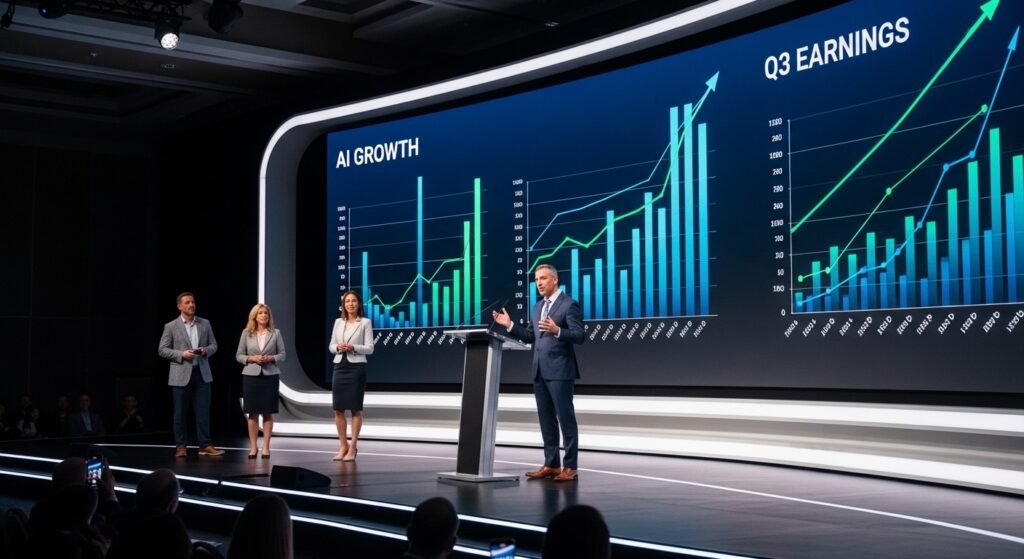
The Big Tech Boom: In October, Big Tech released their Q3 2025 earnings reports. These numbers clearly showed exactly how much money companies are now making from AI.
Google/Alphabet: Google Cloud saw its AI revenue jump by 35% over last year. High demand for the Gemini API drove this massive growth. CEO Sundar Pichai shared that over 2 billion people now use Gemini inside everyday apps like Search, Gmail, Docs, and Maps. To keep up with demand, Google is building massive new AI data centers across the US, the EU, and Southeast Asia.
Microsoft: Microsoft reported a 29% yearly growth in its Azure AI services. CEO Satya Nadella noted that GitHub Copilot now has over 2 million paying business users. Microsoft also poured billions more into its partnership with OpenAI to co-develop next-generation models. This move firmly strengthens their alliance, even as OpenAI restructures into a for-profit business.
Meta: CEO Mark Zuckerberg confirmed a staggering $70 to $72 billion AI investment plan for Meta in 2025. This marks the largest single-year AI investment by any company in history. Today, Meta AI actively serves over 500 million users across WhatsApp, Messenger, Instagram, and Facebook. At the same time, their open-source strategy led by Llama 4 continues to build massive loyalty with developers.
Amazon: Amazon saw huge business growth driven by AWS AI services, including Amazon Bedrock and new AI agent tools. To support this growth, Amazon announced major new AI data centers in Texas, Ohio, and northern Virginia. Finally, Alexa received its biggest AI upgrade in years. It now uses Amazon’s custom AI models to handle real, conversational reasoning.
OpenAI Funding & Restructuring Updates
OpenAI’s Restructuring: In October 2025, OpenAI continued changing its business model. It actively moved away from a capped-profit structure and closer to a standard, for-profit corporation. Earlier in 2025, the company raised a record $6.6 billion. This massive funding round officially makes OpenAI one of the most valuable private tech companies in history.
Altman’s Chip Ambitions: CEO Sam Altman shared OpenAI’s big plans for future infrastructure. He wants to partner directly with manufacturers to build dedicated AI chips. This strategic move will actively reduce their heavy reliance on Nvidia.
Enterprise Upgrades: OpenAI also heavily upgraded the enterprise version of ChatGPT. They added powerful new tools that allow businesses to deploy custom AI agents, improve their organizational memory, and track detailed compliance audit logs.
Massive Global Growth: In October 2025, ChatGPT crossed a huge milestone. It surpassed 800 million weekly active users. This staggering number proves that AI assistants are now essential, everyday productivity tools. OpenAI noted that most of this new growth comes from outside the US. They specifically saw massive adoption across India, Southeast Asia, and Latin America.
AI in October 12, 2025 Technology News — Key Events That Day

A Busy Day in Tech: October 12, 2025, brought massive news across the tech world. Here are the key events:
OpenAI and GPT-5: OpenAI expanded its GPT-5 API for business customers. The company cut prices by about 30% from the original launch rates. This huge price drop makes advanced AI much more accessible for everyday businesses.
Anthropic’s Safety Research: Anthropic published exciting new safety research on mechanistic interpretability. The team shared direct methods to find and understand the specific circuits inside large language models that cause certain behaviors. AI safety experts heavily covered this work. It shows real progress toward making AI systems completely transparent and easy to audit.
Europol’s Threat Assessment: Europol released its October 2025 AI threat assessment. The agency officially flagged AI-enabled cybercrime groups like Qilin, Medusa, Clop, and EvilProxy as major, growing threats. The report specifically highlighted AI-powered ransomware, deepfake fraud, and AI-assisted phishing as the top concerns for global law enforcement.
D-Wave’s Quantum Leap: D-Wave announced a major quantum computing breakthrough for the logistics industry. The company published new results showing a hybrid quantum-classical algorithm in action. This new algorithm solves complex fleet routing problems 40 times faster than traditional methods.
AI in October 25, 2025 — Artificial Intelligence Updates
A Day of Major Announcements: October 25 brought several huge updates across the tech industry. Here are the main highlights:
OpenAI and the Atlas Browser: OpenAI announced its new Atlas Browser on October 24. By October 25, it drew massive media coverage and real-world feedback. Early users praised its impressive tools. However, they also raised serious privacy concerns. The AI actively watches all user browsing activity.
Palantir’s Government Contracts: Palantir secured expanded contracts with the US government. The government will use Palantir’s AI platform to manage defense logistics and healthcare systems. Following this big announcement, the company’s stock price quickly surged.
Scale AI’s Testing Tools: Scale AI released a major update to its data and AI evaluation platform. The team added new tools specifically to test agentic AI systems. Companies urgently need these tools today. They must thoroughly test their autonomous AI agents across complex tasks before launching them.
Feedzai’s Fraud Detection: Feedzai launched a new AI fraud detection system built strictly for agentic commerce. The company realized that AI shopping agents create entirely new types of fraud. Traditional monitoring systems simply cannot catch these advanced threats.
AI Safety, Ethics & Society October 2025

A Warning from AI Pioneers: AI safety took center stage in October 2025. Yoshua Bengio and Geoffrey Hinton, two Nobel-winning AI researchers, published a joint open letter. They urgently called for binding international rules on AI safety. They warned that the fast rollout of agentic AI systems creates major risks. Over 500 other AI researchers co-signed this letter. Together, they strongly urged the UN to quickly create strict AI governance laws.
The Rise of Prompt Injection: Prompt injection attacks became a massive security threat. In these attacks, hackers hide malicious text in web pages to completely hijack an AI agent’s behavior. As more companies used these autonomous agents, the problem exploded. Security experts at F5 and Cisco published alarming new research. They successfully demonstrated real-world attacks against popular AI platforms. This proved that autonomous AI desperately needs better security right now.
Deepfakes Evade Detection: The deepfake crisis also worsened significantly. Researchers at King’s College London tested top-tier deepfake detection tools. They found these tools only caught 68% of the newest AI-generated videos. This is a sharp drop from their previous 85% accuracy rate. It clearly highlights the fierce, ongoing battle between AI video creators and AI security tools.

The AI “Slop” Epidemic: Moderating AI content on a massive scale remained incredibly difficult. YouTube, Reddit, and other major social platforms reported a huge surge in AI “slop.” Creators actively flood these sites with cheap, low-quality AI posts and videos. This junk content constantly drains valuable moderation resources. To fight this, the Free Software Foundation and the Future of Life Institute publicly demanded new laws to stop AI content flooding.
AI Boosting Mental Health: However, October also brought highly positive news. BetterUp, an AI coaching and mental health platform, shared impressive long-term data. The company tracked 50,000 users over 18 months. The study proved that their AI coaching system genuinely boosted employee wellbeing, resilience, and productivity. This stands as one of the most rigorous real-world examples of AI actively helping humans.
The Push for AI Alignment: Finally, Stuart Russell from UC Berkeley gave a famous lecture at Oxford University. He focused heavily on AI alignment. He argued that safety researchers must work much faster to keep up with rapidly advancing AI capabilities. Around the same time, Carnegie Mellon hosted a major workshop on scalable oversight. This crucial research explores exactly how ordinary humans can safely supervise super-smart AI systems.
What’s Coming Next? AI Predictions for November 2025
What to Watch in November: Based on October’s news, we expect several major AI stories to break in November 2025.
New AI Regulations: The EU AI Office will likely publish its first enforcement actions under the new GPAI rules. This will give companies clear examples of how to follow the law. Meanwhile, Japan plans to release its final healthcare AI guidelines. These guidelines will include strict, binding rules for specific medical devices.
Upcoming Model Releases: Rumors suggest OpenAI is preparing new versions of GPT-5. The company will optimize these models for specific jobs like coding, scientific research, and customer service. Also, experts expect Google to announce Gemini 2.5 Ultra. This updated model will feature larger context windows and much better reasoning skills.
The Growth of Agentic AI: Businesses will adopt autonomous AI agents much faster. Major software platforms like Salesforce, ServiceNow, and SAP all plan to massively expand their AI agent tools.
Quantum Computing Milestones: Both IonQ and IBM plan to announce major quantum computing breakthroughs before the end of the year. Because of this, the tech world will start talking much more about how quantum computers and AI can work together.
Healthcare Approvals: The FDA will continue to approve AI medical devices at a very fast pace. Several major AI diagnostic tools will likely receive official clearance before the year ends.
Keep Reading: For more background context, check out our Latest AI News September 2025 roundup.
Conclusion: Key Takeaways from October 2025

October 2025 proved a massive shift in the AI industry. We officially moved past the era of pure experimentation. We have fully entered the era of AI infrastructure. Companies no longer just test this technology. Today, they actively deploy, regulate, and monetize it on a massive global scale.
For Developers: You must focus heavily on agentic AI adoption. You need to learn how to build tools both with and for AI agents. You should also master the Model Context Protocol, as it is quickly becoming the new integration standard. Finally, you must actively defend against growing security threats like prompt injection and AI supply chain attacks.
For Business Leaders: The message is crystal clear. AI is no longer just a future idea. It is a strict competitive requirement today. Companies across every sector actively use AI to improve customer experience, daily operations, and fast decision-making. If you ignore this shift, you will quickly fall behind rivals who already use these powerful tools.
For Policymakers and Compliance Officers: October 2025 officially launched the enforcement era. The EU AI Act now actively enforces its rules. Japan’s guidelines are becoming strict, binding laws. Meanwhile, the US actively expands its own complex web of state-level regulations. You must completely understand which laws apply to your specific AI systems. Creating clear documentation, strong oversight, and tight audit features is now a mandatory business task.
Looking Ahead: The pace will not slow down. November 2025 promises even more model releases and strict regulatory updates. We will see AI transform completely new industries in ways we only dreamed of a year ago. Stay informed, stay curious, and keep building!
FAQ: Your Top Questions About AI News October 2025
What were the biggest AI breakthroughs in October 2025?
October brought several massive breakthroughs. OpenAI launched Sora 2, a powerful new video generation model. Businesses actively rolled out agentic AI systems on a massive scale. Nvidia crossed a historic $5 trillion market cap. Medical researchers made huge leaps in AI-driven cancer drug discovery. OpenAI also released the Atlas Browser, a fully AI-native web browser. Finally, the EU AI Act’s strict new compliance rules officially took effect.
What new AI models were released in October 2025?
Tech giants released several major updates in October. OpenAI launched Sora 2 and integrated GPT-5 into its Atlas Browser. Anthropic updated Claude Sonnet 4.5 to improve its computer use skills. Google rolled out big updates for Gemini 2.5 Pro. Meta vastly improved Llama 4. Qualcomm and Apple advanced their on-device AI models. Top enterprise platforms like Salesforce, ServiceNow, and GitHub Copilot also released massive AI updates.
What is the EU AI Act and what changed in October 2025?
The EU AI Act is Europe’s massive new AI law. It sets strict rules for AI systems based on their specific risk levels. In October 2025, the General Purpose AI (GPAI) rules officially took effect. Now, AI developers must submit detailed technical documents, run safety tests, and prove their transparency. Companies building ultra-powerful models face even stricter rules. They must perform mandatory risk assessments and actively report any safety incidents.
How did Nvidia reach a $5 trillion valuation?
Nvidia hit this massive valuation because it completely dominates the AI computing market. Its powerful GPU chips, especially the H100 and new Blackwell series, run most of the world’s AI training. As AI investments exploded, companies desperately bought Nvidia’s hardware. This massive demand drove their revenue through the roof. Furthermore, Nvidia’s CUDA software strongly locks customers into their ecosystem. The company is also actively expanding into quantum computing with CUDA-Q, which fuels even more long-term growth.
How is AI being used in healthcare in October 2025?
AI actively transformed healthcare across multiple areas in October. It helped researchers discover new cancer drugs. It analyzed diagnostic images to detect prostate cancer just as well as human specialists. Doctors used Microsoft’s Dragon Copilot to cut their paperwork time by 40%. Swisslog Healthcare used AI to perfectly verify pharmacy medications. Hospitals even used robots like Diligent Robotics’ Moxi to handle daily logistics. To keep up, major regulators like the FDA and Japan’s PMDA released brand new safety rules for AI medical devices.
What are AI agents and why are they important?
AI agents are smart systems that plan and finish complex, multi-step tasks all on their own. They do not just answer single questions. They actively browse the web, write code, manage workflows, and buy things without human help. In October 2025, businesses finally moved these agents out of the testing phase and into the real world. Platforms like Salesforce Agentforce and GitHub Copilot deployed these active agents to millions of users.
What is Japan’s approach to AI regulation in October 2025?
Japan actively released new Generative AI Guidelines in October. These guidelines created specific rules for healthcare, finance, and critical infrastructure. Japan’s PMDA also issued clear safety rules for AI medical devices. The Personal Information Protection Commission set new limits on how companies can use patient data to train AI. Overall, Japan seeks a balanced path. The country actively promotes AI innovation while building safe laws that align with both US and EU standards. You can read more in our full Japan AI Regulation News 2025 guide.
