
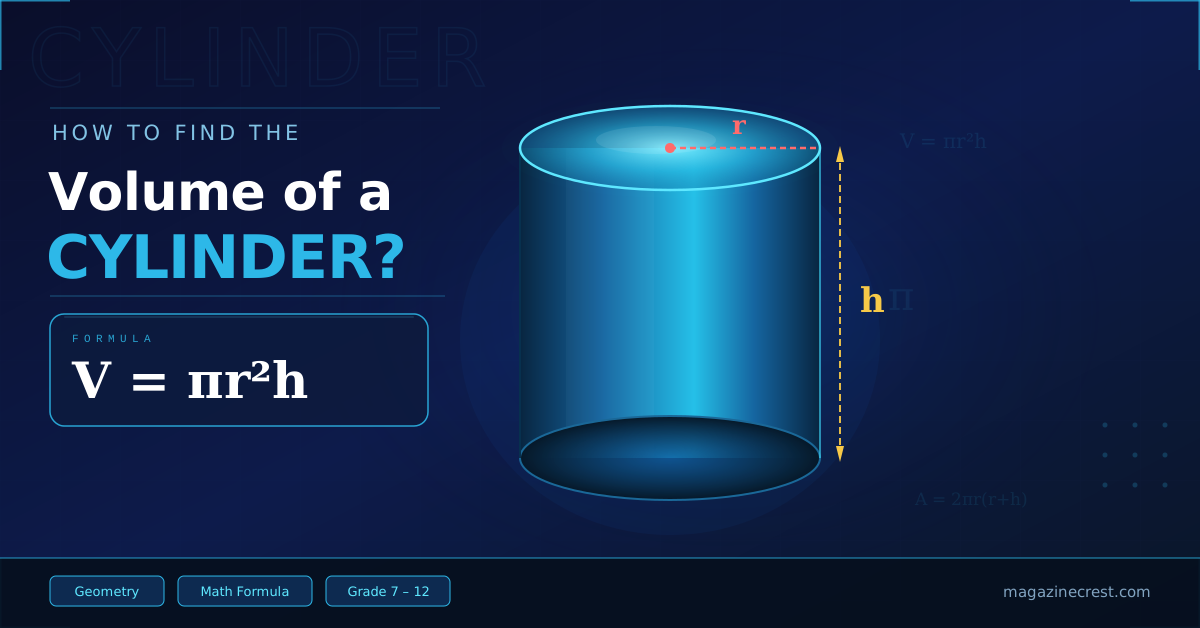

The volume of a cylinder is the amount of space inside a cylinder. To find the volume of a cylinder, use the formula V = πr²h, where r is the radius of the circular base and h is the perpendicular height.
Students first encounter the volume of cylinders in Grade 7 geometry, revisit it in Grade 8, and apply it more formally in high school geometry. This guide covers the formula, an interactive 3-D diagram, 6 fully worked examples, Common Core State Standards (CCSS) alignment, teaching tips, easy mistakes, and 6 practice questions with solutions. You can also check any calculation instantly with the free Cylinder Volume Calculator.
What is the volume of a cylinder?
What is the volume of a cylinder?
The volume of a cylinder is the total amount of space enclosed inside the cylinder. It represents the filling capacity — how much liquid, gas, or material the cylinder can hold.
To calculate the volume of a cylinder, first find the circular area (A) of the base using the formula for the area of a circle:
Then multiply that circular base area by the perpendicular height of the cylinder to get the formula for the volume of a cylinder:
For example, to find the volume of a cylinder with a radius of 7 cm and a perpendicular height of 10 cm:
Interactive Cylinder Diagram
Drag the sliders to change the radius and height — watch the cylinder and volume update in real time.
Common Core State Standards
The volume of a cylinder appears at 2 key stages of the Common Core State Standards (CCSS):
Solve real-world and mathematical problems involving area, volume, and total surface area of two- and three-dimensional objects composed of triangles, quadrilaterals, polygons, cubes, and right prisms.
Use volume formulas for cylinders, pyramids, cones, and spheres to solve problems.
How to calculate the volume of a cylinder
To calculate the volume of a cylinder, follow these 4 steps every time:
Write down the formula: V = πr²h
Substitute the given values — the radius r and perpendicular height h — into the formula.
Work out the calculation using a calculator or by hand, following the correct order of operations.
Write the final answer, including units (cm³, m³, in³, etc.), rounding to the required degree of accuracy.
Volume of a cylinder examples
Example 1: volume of a cylinder
Find the volume of the cylinder with radius 3 cm and perpendicular height 5 cm. Give your answer to 1 decimal place.
Write down the formula.
Substitute the given values. r = 3 cm, h = 5 cm.
Work out the calculation using a calculator.
Write the final answer, including units. Round to 1 decimal place.
Example 2: volume of a cylinder
Find the volume of the cylinder with radius 4.8 cm and perpendicular height 7.9 cm. Give your answer to 3 significant figures.
Write down the formula.
Substitute the given values. r = 4.8 cm, h = 7.9 cm.
Work out the calculation.
Write the final answer, including units. Round to 3 significant figures.
Example 3: volume of a cylinder
Find the volume of the cylinder with radius 3 cm and perpendicular height 7 cm. Leave your answer in terms of π.
Write down the formula.
Substitute the given values. r = 3 cm, h = 7 cm.
Work out the numerical part only (keep π as a symbol).
Write the final answer, including units.
Example 4: volume of a cylinder
Find the volume of the cylinder with radius 4 cm and perpendicular height 10 cm. Leave your answer in terms of π.
Write down the formula.
Substitute the given values. r = 4 cm, h = 10 cm.
Work out the numerical part only.
Write the final answer, including units.
Example 5: using the formula to find a length
The volume of a cylinder is 1600 cm³. Its radius is 9 cm. Find the perpendicular height. Give your answer to 2 decimal places.
Write down the formula.
Substitute the given values. V = 1600 cm³, r = 9 cm. Solve for h.
Rearrange to find h.
Write the final answer, including units. Round to 2 decimal places.
Example 6: using the formula to find a length
The volume of a cylinder is 1400 cm³. Its perpendicular height is 15 cm. Find the radius. Give your answer to 2 decimal places.
Write down the formula.
Substitute the given values. V = 1400 cm³, h = 15 cm. Solve for r.
Rearrange to isolate r.
Write the final answer, including units. Round to 2 decimal places.
Teaching tips for volume of a cylinder
Use real-world objects. Bring physical cylinders — cans, jars, tubes — to class. Students who connect the formula to an object they can hold retain it far longer than students who only see it on a board. Visual aids also help English Language Learners grasp three-dimensional space.
Build the 4-step habit from day one. Require students to write V = πr²h before substituting any values. This prevents order-of-operations errors and creates a consistent, transferable problem-solving structure.
Incorporate group measurement tasks. Have students measure cylindrical containers with rulers, apply the formula, then verify using water displacement. Open-ended extensions — such as finding surface area alongside volume — scaffold learning across related geometry topics.
Expose students to multiple cubic units. Practice with cm³, m³, in³, ft³, and mm³. For liquid contexts, connect 1 cm³ = 1 mL (milliliter) to make volume feel practical. Diverse unit experience reinforces three-dimensional measurement across real-world scenarios.
Easy mistakes to make
Using diameter instead of radius. The formula requires r (radius), not d (diameter). When a diameter is given, always halve it first: r = d ÷ 2. Using the diameter directly doubles the intended radius and quadruples the volume error.
Squaring the wrong term. The formula is V = π × r² × h. Only r is squared — not π, not h, not the entire product πr. Write the calculation as π × (r²) × h to make the grouping clear.
Omitting cubic units. Volume is always three-dimensional. An answer without cm³, m³, or equivalent is incomplete. One missing unit label costs marks in exams and signals a conceptual gap.
Rounding π too early. Using 3.14 mid-calculation introduces cumulative rounding error. Keep π as a symbol until the very last step, or use your calculator’s π button throughout.
Ignoring order of operations. Square r first, then multiply by π, then multiply by h. Skipping this sequence — for example, multiplying r by h before squaring — produces an incorrect result every time.
Verify any cylinder calculation instantly
Enter a radius and height to get the exact volume with full step-by-step working.
Open Cylinder Volume Calculator →Practice volume of a cylinder questions
1) Find the volume of a cylinder with radius 3.2 cm and perpendicular height 9.1 cm. Give your answer to 3 significant figures.
Show solution
2) Find the volume of a cylinder with radius 5.3 cm and perpendicular height 3.8 cm. Give your answer to 3 significant figures.
Show solution
3) Find the volume of a cylinder with radius 8 cm and perpendicular height 7 cm. Leave your answer in terms of π.
Show solution
4) Find the volume of a cylinder with radius 4 cm and perpendicular height 8 cm. Give your answer to 3 significant figures.
Show solution
5) The volume of a cylinder is 250 cm³. Its radius is 2.9 cm. Find the perpendicular height. Give your answer to 2 decimal places.
Show solution
6) The volume of a cylinder is 800 cm³. Its perpendicular height is 9.2 cm. Find the radius. Give your answer to 2 decimal places.
Show solution
Volume of a cylinder FAQs
How do you find the volume of a cylinder?
Find the volume of a cylinder by using the formula V = πr²h. Substitute the radius (r) and perpendicular height (h), evaluate using a calculator, and write the answer in cubic units. Use the free Cylinder Volume Calculator to check your working.
What is the formula for volume?
The formula for the volume of a cylinder is V = πr²h, where π (Pi) ≈ 3.14159, r is the radius of the circular base, and h is the perpendicular height. This gives the cylindrical space occupation in cubic units such as cm³ or m³.
What is the volume of a circular cylinder?
The volume of a circular cylinder equals the area of its circular base multiplied by its perpendicular height: V = πr²h. The circular base has area πr², and projecting that base area through height h fills the three-dimensional cylindrical space.
What is the simple volume of a cylinder?
The simplest expression for the volume of a cylinder is: base area × height. Because the base is a circle, base area = πr², making the full formula V = πr²h. For a cylinder with radius 3 cm and height 5 cm: V = π × 9 × 5 = 141.4 cm³ (to 1 decimal place).
What are common mistakes to avoid when finding the volume of a cylinder?
4 common mistakes to avoid are: using the diameter instead of the radius, squaring the wrong term in the formula, omitting cubic units from the final answer, and rounding the value of π too early. Double-check each step and keep π unsimplified until the final computation.
Are there different units I can use for cylinder volume calculations?
Yes. Cylinder volume calculations use various cubic units, including cubic centimeters (cm³), cubic meters (m³), cubic inches (in³), cubic feet (ft³), and cubic millimeters (mm³). For liquid contexts, 1 cm³ = 1 mL (milliliter) and 1,000 cm³ = 1 litre (L). Keep units consistent throughout each problem.
How can I ensure I include the correct Pi value in cylinder volume calculations?
Keep the symbol π in every step and only substitute its numerical value (approximately 3.14159) at the very last step. Use your calculator’s dedicated π button to avoid rounding errors mid-calculation. Rounding to 3.14 early in the process introduces compounding error, especially for larger cylinders.
What are practical examples to better understand cylinder volume calculations?
3 practical examples that reinforce cylinder volume calculations are: finding the precise filling capacity of a drinks can (r ≈ 3.3 cm, h ≈ 11.5 cm → V ≈ 393 cm³ ≈ 393 mL), calculating how much water a cylindrical water tank holds, and determining how much concrete fills a cylindrical pillar. Experiment with real dimensions using the Cylinder Volume Calculator.


